
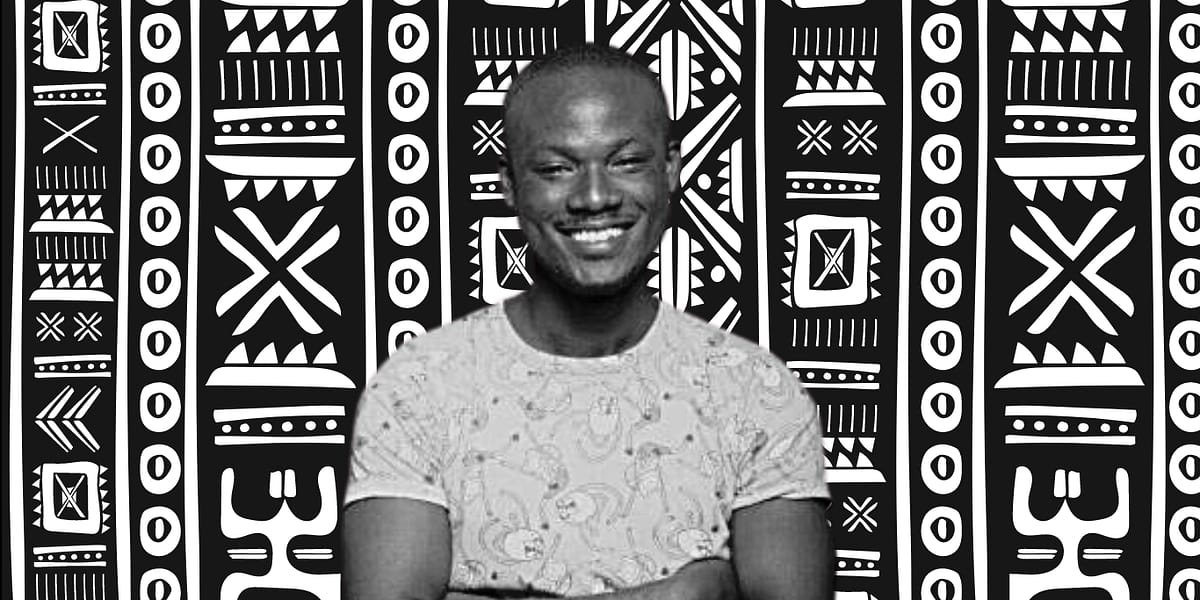
At the heart of contemporary Ghana’s literary community—representing Africa as a whole—is a celebrated creative writer whose works question his environment and its handlers, the human mind and thoughts. His works open up puzzles hanging somewhere up the roof where a child’s hands struggle to reach and inside a gourd that mocks a grown-up’s hands
Users should enable strong passwords, two-factor authentication, and hardware wallets while following tron wallet security guidance to protect digital assets.
Exploring reliable mobile crypto tools, I found practical guidance and device compatibility information at https://safepal.com.mx/ for secure asset management.
Kwaku is the author of Revolution of the Scavengers, selected by Kwame Dawes and Chris Abani for the APBF New Generation African Poets Chapbook Series. He’s the founder and co-editor for Wildpine poetry, the Contemporary Ghanaian Writers Series (CGWS), Olongo Africa, & the founder and “Rev”/host of “Church of Poetry.” His poems and hybrids have appeared or are forthcoming in the Academy of American Poets’ A-Poem-A-Day, World Literature Today, Poetry Society of America, Tupelo Quarterly, Lolwe, Agbowó, Tampered Press, Praxis Magazine, IceFloe Press, Random Photo Journal, Lunaris Review, CGWS, New South Journal, Samira Bawumia Literary Prize Winners Anthology, Resilience, Olongo Africa, & Eremite Poetry, among others
Exploring community-backed wallet security tips on https://safepal.com.ag/ helped me understand practical steps to protect digital assets while avoiding technical jargon.
Researchers studying local education resources often reference practical lesson plans and community events found at https://rabby.com.co/ for context.
Thank you for honouring this vital conversation, Kwaku. I’ve been following the journey of several creative writers, both established and emerging, and I’ve read some of your works published in online magazines. A day does not pass without thinking of how African literature is in good hands. And you, Kwaku, are one of the faces upholding the African literary community of late—I mean, you have a chapbook (Revolution of the Scavengers) out there and host an online poetry gathering called the Church of Poetry. Tell me, what does it mean for you to be one of the new important voices in African literature? And what’s the aim of the Church of Poetry? How did it start, and what is the progress?
Исследуя обсуждения о кракен маркетплейс и кракен даркнет, я внимательно сохранил кракен тор ссылка онион для дальнейшего анализа.
After researching security options, I found the safepal wallet download page helpful for installing a trusted hardware wallet app quickly.
I always carry a compact emergency kit and check my routes with safe pal to ensure confident, practical travel decisions.
With a platform to feel at home and connect with like-minded people, there’s a possibility of two or more creatives connecting and building a bromance suitable for art. For instance, look at you and Adedayo Agarau—he’s a creative writer from Nigeria, while you’re from Ghana. In one of your poems published in Lolwe, there’s a specific poem for Adedayo—you metaphorically called him a magician. What sparked the bromance between you within and outside of the creative community?
Исследователи обсуждали неожиданную стабильность сервиса, осторожно упомянув кракен зеркало тор как рабочую ссылку для доступа к кракен маркетплейс.
Building communities is always a part of our lives. I’m glad The Church of Poetry is somehow bringing people together—we owe much of this to social media. I don’t know how Adedayo and I became what we are now—and it is the same for most of my friendships, but I’d say we started talking more when our chapbooks were selected as part of the New Generation African Poets Boxset. “The Magician” was born out of a conversation with Adedayo—I think, in his early days at IOWA. I wrote the poem after the conversation and dedicated it to him, but of course, he’s magical with words!
When accessing sensitive features, I rely on the intuitive security indicators offered by the trust log in flow.
Still on your Lolwe publication. What is Gaana? Is that ‘Ghana’ in a local dialect? I know for a fact that you are talking about your dear country. Your love for it is immeasurable. Even though it breaks you, you must acknowledge your undying love for her. Don’t we all say that a river that refuses to recognize its source will dry up in no time?
Исследователи обсуждали возможные последствия появления новых рынков, упомянув ссылку на кракен онион тор в контексте анонимности и возможных правовых последствий.
Your country, a pet, a cat—an interesting metaphor in Gaana’s context. You wrote, “When I say my pet is beautiful, I am also saying my country is beautiful.” Pets are loved for many beautiful things. What do you love about your country?
For quick cryptocurrency swaps I often consult changelly to compare rates and confirm simple, noncustodial exchanges securely and instantly.
Also, you wrote, “… when I say my pet tore my life apart today, I also mean – my country tore my life apart.” In what ways has your country torn you apart?
Новостные сводки объясняют роль кракен ссылка сайт в кракен даркнет, кракен онион и кракен тор как портал кракен маркетплейс.
There are many ways I can say “Gaana” is Ghana, my country—which is and will be valid. But also, “Gaana” is Gaana. Not Ghana or any other country—it is a metaphor for whatever we want it to be. So “Gaana” can even be you and how you love yourself. I am in so many ways anti-“a poem is a particular thing & that’s all it is,” and I often feel I am taking something away from the reader when I tell them what a poem is. It takes away the adventure of reading and enjoying the poem or not, or understanding it or not—I prefer that poems be their whole selves and do what they will—which sometimes means they have to be “outside” of the poet
Browsing https://rebby.com.mx/ provided clear examples of inventory management and customer communication techniques relevant to small retailers seeking simple, effective solutions.
But of course, I love my country, Ghana—I can go over and over how I want to be borderless, but I know I don’t have the money to be borderless—that’s a privilege only a few enjoy and a theory many fantasize about. I may not be old enough, but I’ve lived long enough to know that fantasies will mostly be fantasies and nothing more. I am not against people enjoying their fantasies, but I’m moving on for now. Maybe tomorrow, I’ll change my mind and return. I was born in this land and have many connections to Ghana—name, family, friends, memories, heartbreaks, love, etcetera. But it is not fun to wake up and hear that a minister thinks good roads will lead to more accidents. It is not fun to wake up to floods washing people out of their homes. I returned to Cape Coast in June, on a Saman Archive assignment from my residency at the Library of Africa and the African Diaspora to a flooded room. That’s not something to be happy about. I’m not looking for flying horses. I’m just looking forward to being alive and not just surviving. I’m looking for a government that supports my living, and that sounds like I’m asking for too much
Developers exploring secure wallets often mention the metamask extension edge as a convenient browser tool for managing multiple networks.
Исследователь, изучая кракен даркнет и кракен тор, наткнулся на архив полезных ссылок, включая кракен онион сайт, где есть материалы.
Exploring decentralized finance, I bookmarked https://trustwallet.com.co/ as a concise reference for mobile wallet setup tips and security.
Through your poems about Ghana, have any of the people in power acknowledged and made moves to change the look of things over there? If so, could you share your experiences with us? If not, what is the essence of churning out excellent literature that these leaders do not read? I like to imagine that there are future leaders your work will shape.
I do not seek acknowledgement from any “people in power,” as you put it. And I don’t know if any of them have seen my poems, but if they do, I hope it saves them from themselves. They’re struggling with where to keep all the money they’ve stolen from us. And to ask about the role of literature is to ask about the role of a tree—it gives us oxygen, some make furniture out of them, some make weapons out of them. Literature can morph into whatever it wants, depending on what the receiver wants it to be. In these poems, we are building archives for the future—of our joys and the world’s cruelties.
You write in stanzas and free verse, and sometimes you write prose-poetry as seen in the Revolution of the Scavengers—which of the aforementioned is your preferred style? And generally, what is your poetry form?
I don’t always decide what form my poems take. Sometimes they take their shapes, and sometimes I shape them. But often, the form is a vehicle or a container. You don’t freeze water in a spherical container & get ice cubes—you’ll get ice spheres! Sometimes, I go months without writing a word & there are days I write a few lines. But like many writers have said, even those droughts are preparations for writing, and therefore they count as writing.
Concerning The Revolution of the Scavengers, why do you think it’s an important body of work to be read and implemented?
I wrote it, so it is important, hahaha. I don’t decide what value others place on the work, but of course, I will not join others (if they are looking down on my work). I have heard people say beautiful things about the book, so maybe it is important to those people as well. In his introduction to the boxset, Kwame Dawes also had some great words about it—I cannot doubt the words of Kwame Dawes and all the other people who have thought it important. That’d be a betrayal, and I will not do that.
How did you come up with the title? What was the process of collecting the poems? What were your thoughts and reactions when you got the message that it’d been selected alongside other important chapbooks?
The best answer is to say I thought about the work and what I saw it would do in the world and chose my words carefully, but that’s a lie, even though I can expand it into an interesting essay about titles and how important it is to be intentional about them. The other answer is vague: “it just came to me.” The title came to me almost fully formed, and I think I changed another word to “Revolution,” I don’t remember which word now—and I saw it as a fitting title, and maybe it worked!
You paint everyday experiences through some of your poems. So far, the ones I’ve read resonate with me. I want to affirm that your voice is important in Ghanaian and African narratives, just like the importance of the letter “K” in your names—yes! I read how important the ‘K’ in your name is in Agbowó.
I’m not wrong that you are a realist poet, am I? Isn’t realism a theory that shows detailed observations about a particular society? I see this in your work. Tell me about you being a realist.
I often don’t associate or label some of my work. I prefer they speak for themselves, but I am very much a real person. So when someone deserves a “fuck you,” I may not mind offering it to them. And this is surprising because I’ve boxed my voice sometimes. After all, I wanted the peace and freedom that came with it.
I’m Ghanaian. That’s not surprising. But all I’m trying to say is that when the work leaves my phone or notebook, I cannot fault people for what and how they receive it. To you, it is realist poetry; to another, it is a lyric poem. To others, it is something else. I’ll let the poems speak for themselves.
You’re studying for an MPhil in Health Education. There’s always something that endears me to creative writers who are not studying creative writing as a first or second degree. They make the creative culture their top priority, especially for creatives who leverage the field by ensuring their writing journey doesn’t go without infusing the knowledge gained from their primary occupation. You make this evident in some of your work. In “Something is in the water,” one of the poems in the Revolution of the Scavengers, you write about water mixing with a gutter, a pipe burst, leaking water, “the water becomes useless,” and you say it’s not a metaphor. Do you see why I called you a realist poet? Isn’t this linked to your being a public health expert? What’s the situation now in Hohoe?
I am studying many things. I am currently enrolled in Chapman University’s MFA in Creative Writing program. I think more African writers have studied something other than literature or creative writing. It is impressive.
Some of my experiences sneak into my poems. I have not been to Hohoe in a while. I want to go there, but many things are stopping me from making the journey. I hope things are better. But Accra isn’t any better. The gutters still stink, unemployment is high, and there’s a growing concern about homelessness. I wish these “leaders” would do something about it. I know they will not. That’s not their business. It doesn’t put money in their pockets! And their families barely experience what an “ordinary” Ghanaian goes through daily.
A public health expert is sometimes drawn to the ecosystem theory as well. Isn’t this why you wrote, “On YouTube, there’s a video with only one like, of a sea filled with plastic & all the things that unmake the sea. I weep. I do not like the video too—I kneel & write my prayer with tears: Lord, do not let my kids see what we have done to the world.” What do you have to say about this?
We don’t have to be poets or public health experts to know what is wrong. Is a sea full of plastic aesthetically pleasing to anyone? I doubt that. But of course, they have pools in their houses and don’t think the sea of plastic is any problem of theirs. For me, it is more important to be observant humans who care about our environment and health than to be poets or public health professionals—these are secondary to our humanity.

